

Blade director Q&A: Bassam Tariq on working with Marvel, his favorite games and more
Bract director Q&A: Bassam Tariq on working with Marvel, his favorite games and more
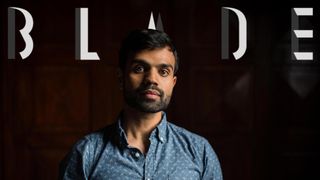
MCU fans made a collective shrug when news bankrupt before this summertime that Bassam Tariq, the documentarian backside These Birds Walk and Ghosts of Sugar Land, had been signed to direct Marvel's Blade, starring Academy Award winner Mahershala Ali. Merely this relatively repose and underground filmmaker has speedily defenseless the attention of the biggest names in blockbuster cinema.
Tariq, a Pakistani immigrant who grew up in New York and Houston, has been known in arthouse circles for making serious films about the diaspora experience, exclusion and politics. His well-nigh contempo film, Mogul Mowgli, starring University Laurels winner Riz Ahmed, deals with an near famous Pakistani-British rapper who succumbs to a mysterious illness that stops his career at a critical point. It's a movie about warring identities and partitional trauma, i wrapped in a 4:3 bundle that's both surreal and anxiety-ridden.
- How to watch Marvel movies in order
- Best Netflix documentaries
Mogul Mowgli finally saw its U.S. theatrical premiere back in September at the Film Forum in New York. Tariq was on-hand to talk about both Mogul Mowgli and Blade with Tom's Guide. (Total disclosure: Bassam Tariq is a long-time friend, every bit nosotros grew up together.)
Below is a transcript of our conversation that's been edited downwardly for brevity. Some questions have been reordered for flow and clarity.
Tom'southward Guide: So, how does someone prepare for a role like directing Blade?
Tariq: One thing that I'm learning to do is just only really lean on the incredible resource that Marvel has given me.
I take an incredible author [Stacy Osei-Kuffour]… she's a partner in law-breaking. I have, of course, Eric Carroll, who is a bang-up producer. Kevin Feige is, I actually think, a brilliant mastermind. Being able to be in a room with him, and see how he processes things is pretty damn amazing. So, of class, there'south Mahershala, who'due south at the heart of it all, at the heart of this.
Kevin Feige is a brilliant mastermind. Beingness able to be in a room with him, and see how he processes things is pretty damn amazing.
Bassam Tariq
I'one thousand in their service. Yeah, I'k trying to know that I'm not alone. And when I know that you're not alone, that it all just starts to feel a lot easier. And that's what's and then groovy virtually — Marvel's has had success with emerging filmmakers coming into this arrangement.
But [to] be coming into their incredible library of films… I'g just honored to be part of that and learn from that.
TG: You're known for directing These Birds Walk and Ghosts of Carbohydrate Land. I is following a bunch of delinquent kids in Karachi. The other is post-obit a friend who joins ISIS. These are actually, actually heavy topics. Going from documentary to vampires is a big spring. Tell me about your relationship with nerd culture.
Tariq: I follow the industry and comic books and stuff, I was really connected to it.
A lot of people in the art house circle, what I've more often than not felt, come from privilege, right? Similar the people that went to prep schools, that went to really dainty places. Actually slap-up universities… A lot of people that are into genre stuff are the kind of friends that I grew up with. Working course kids, whatever it is, right? I really experience more at home.
But the funny affair is, I institute information technology easier for me to kind of come up into this art house infinite considering it felt more of an easier access. ...I grew up going to Silverish Historic period comics in Astoria, I notwithstanding go visit information technology. I bought my son his kickoff comic. By Ming Le, information technology's the Green Lantern, called Legacy. Information technology's for young kids. And he read the whole matter, and it'southward about, you know, ancestors, and it's merely cute.
TG: A kid back at the high schoolhouse you went to is probably asking themselves how they could one day direct a Marvel movie. What communication would you give?
Tariq: Don't call back nearly want[ing] to directly a movie at Curiosity.
I was listening to David Lowery who did The Green Knight recently. He said — it's so cute, and this is something that I just would wish to tape on the wall and merely share with everybody. He said that like 'as a filmmaker, yous brand these films and these people see 'em or not, then i day, yous'll die. But the 1 affair that you accept is how you present yourself to people around y'all and how you carry yourself [with] integrity.' That was only like, man — that's what information technology'south most.
I would only tell everyone to merely find a rhythm for yourself, right? Get off social media at an early age, because this stuff will start messing with your mind.
But there'southward no i manner that anyone comes into making these films… Everyone's journey is unlike. Everyone's journey is beautiful, correct? Chloe Zhao, she made three actually compelling films at a smaller scale, and she made Eternals. You await at Destin [Daniel Cretton]. He's done really amazing films, four or five heartfelt films. And he fabricated Shang-Chi, right? And John Watts [Spider-Homo Homecoming, Far From Home, No Way Domicile]. Like, these are incredible filmmakers. Just they also had a potent idea. Strong frame. Yous tin can come across an authorship. You can see a style in their piece of work.
TG: One matter I noticed when watching Mogul Mowgli was that the scenes felt very claustrophobic. It's like, you're in a nightmare, where your trunk isn't cooperating with you, and the rules of the world that you've conjured aren't off-white.
Tariq: Something with cinema that I actually like is nosotros all have our ain perspective. And we all bring something special to it. I like reading the reviews where people don't like the moving-picture show. It'south exciting to encounter what they idea of it and sometimes. I'll exist similar, "wow, they're actually right." Or I'll completely disagree with somebody.
Liking something or non liking it doesn't actually matter as much as what am I actually understanding, and how practise I see it.
TG: You pursued the arts. Our fathers maybe pursued more secure careers. Is in that location some type of apologue between Mogul Mowgli and your own life?
Tariq: I don't know. I hateful, y'all put yourself in everything, you know? So I wouldn't want to say that that's such you know, that.
There'southward no roadmap for this, right? We don't have an Uncle Hussein, that's like running Paramount. We don't got nobody that's like an SVP of acquisition at Netflix.
Information technology happens for even like working course white people, that happens to a lot of black kids that get to college. When you come from the working form, when you lot're a person of colour, you go, 'I'm going to do something that's secure. I'm non going to become into the arts.' And it's similar, 'why would I get a degree in that? That'due south so dumb.' But even me, I didn't get a degree in motion-picture show. I got a caste in advertising considering I could graduate and get a tangible job.
The idea of even being a filmmaker was like, out of my mind, like, it's impossible. It was only when I met Musa Syeed, a filmmaker, and I became his roommate that I realized, 'oh, this is possible,' right? Someone had an ethical framework, and a cinematic sensibility that I could connect with and I was like, 'oh, this is possible.'

We don't have an Uncle Hussein, that'due south like running Paramount. We don't got nobody that'south similar an SVP of conquering at Netflix.
TG: You're honest to a mistake at times. Only when you're non dealing with documentaries and you're dealing with bodily people and actors and egos… has that quirk about your personality benefited you lot or injure you lot?
Tariq: I recollect that honesty is really important. Has it hurt me? I recollect the thing is restraint is important, right? Knowing how to be honest. The thing that I'll say is that having a sharp tongue isn't helpful. And I know that sometimes your words tin can be — my words can exist hurtful to people that I love, and I care about. And then it's something that I think a lot about.
It'south like, how practice you present yourself and how do you say things that are honest, just also knowing that, what are yous actually really trying to say too, and so I recall that that'south been tough.
But I recollect — I don't desire to lose the honesty because I practise think that there is as well an element of when y'all're a manager, yous want to make sure that your team feels rubber. And you just can't be similar, 'I'k feeling blah blah blah,' and everyone feels unhinged, so that's also actually scary, because you gotta agree down the fort… Because you're also a director beingness a performer, right? Information technology'south your job to perform to a sure caste and deed a sure way when you're presenting yourself.
TG: Was there an example where you might have said something that you think maybe hurt the shoot for the twenty-four hour period?
Tariq: I came from documentary [film-making]. And I didn't know even how to talk to Riz… and so like, I learned with him how to talk to him… he goes, 'in that location'southward a way to talk,' merely he's saying 'in that location's a fashion to talk to me,' correct? Oh, just the fact that he knows that most himself. And he was also willing to exist honest, and be like, "hey, await, here's a way that nosotros tin try this." That was amazing. And I had to [say], 'cheers. I needed to hear that.' I didn't become 'who the f$#k is he to tell me! I'm the director.' Which is something some people will say, right? And that's their manner of directing.
Like, in that location's some people that would say that I call cut when I desire to call cut. Well, some actors are like, "look, don't call cutting right now" because that messes with them. 'But let me finish, considering I'k in a flow, and I'grand trying to figure it out.'
And so, it's a question: what kind of a person do you lot desire to be and how do you want to bring yourself? So for me, look, we're all in this together.
My favorite filmmaker's [Andrei] Tarkovsky, who had a really strong authorship. And even he admits that he found truth in dispute. That he needed other people around him to observe it. And then that'south what I like about this, is that we piece of work together to detect — it'southward a dance.
The filmmakers that I'g speaking to at present that I like, that are making really excellent comic volume films, they're as well gamers
TG: I've always felt yous've had this internal struggle. One where y'all want to present yourself as this serious managing director making serious piece of work. Simply likewise one that wants to nerd out on The Legend of Zelda or Final Fantasy. Explain this rift.
Tariq: The filmmakers that I'grand speaking to now that I like, that are making really fantabulous comic book films, they're too gamers. And they explore the world of gaming. It's and so funny, recollect, similar, when I watched Children of Men. First thing I said to my friend was, "this is like Half Life two, right?" And then I remember the funny matter is, I was such a nerd man, I can't believe information technology. I went to Alfonso Cuarón one time… And I go like, "take you lot played Half Life 2?" And he's like, "what?"
"Information technology's this game like, Half Life ii, It's, it's literally came out right before Children of Men and information technology's dystopian, apathetic, blah" [and] he's just like "no, I've never, never heard of it."
Unfortunately, gaming in the past has kind of gotten a bad rap of not beingness in creative art, like not actually an art form. And it's simply a bunch of bros that play. There is probably a dimension of that that's truthful. Simply I also think that at that place are a lot of phenomenal games. Like a game that doesn't take anything to do with Blade, just I love is Expressionless Cells. I played Expressionless Cells to decease. And when I was working on Mogul Mowgli man, I was literally playing Dead Cells every night.
TG: What's your favorite game? Or your favorite video game moment.
Tariq: I would say that Chrono Trigger is one of my favorite games. And my favorite moment in Chrono Trigger would exist when Crono risks his life, and he dies. And and so you're similar — spoiler alert — and then yous got to go back in time, and then create a statue of some kind and so supercede his body. And I retrieve doing that as in the game, and I was similar, maybe ten or eleven. I was just like, 'this is so incredible.' And information technology even so sticks with me.
The reason why we're so invested in these games is because we are actively — they are avatars for us. So so when the avatar makes a decision that is on screen that we ourselves didn't brand, nosotros're not going to connect. Considering yous tin can't tell me Mario's personality. Right?
I don't know if Mario has a personality. Mario is like a fun matter. But you control Mario and then you give Mario his personality, which is so profound. At that place'southward a reason why Mario doesn't have long monologues or soliloquies. Information technology'due south the same affair as Link, right? You know who Cloud is. Cloud is brooding? He's got a lot of guilt in him. But information technology'southward different. Like, that'due south what's so exciting about these silent protagonists is that you are them.

Source: https://www.tomsguide.com/news/blade-director-bassam-tariq-dishes-on-working-with-marvel-his-favorite-games-and-more
Posted by: woodruffthavir1976.blogspot.com
0 Response to "Blade director Q&A: Bassam Tariq on working with Marvel, his favorite games and more"
Post a Comment